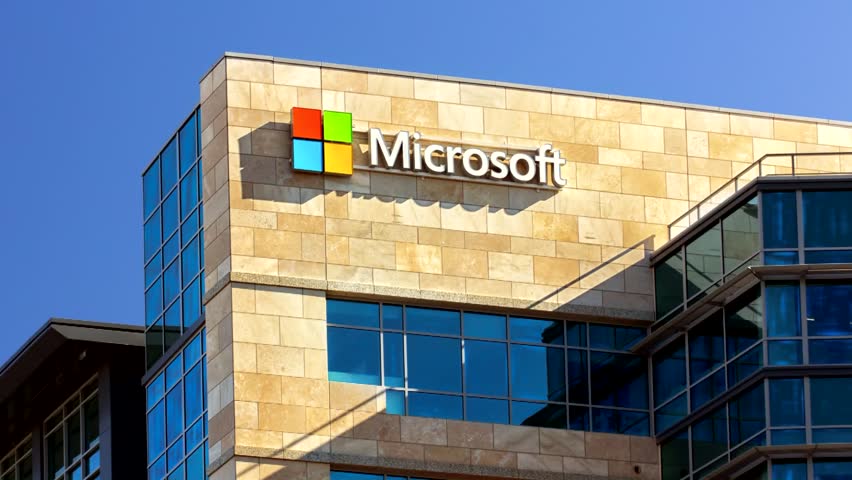
Microsoft Corporation is an American multinational technology company with headquarters in Redmond, Washington. It develops, manufactures, licenses, supports, and sells computer software, consumer electronics, personal computers, and related services. Its best known software products are the Microsoft Windows line of operating systems, the Microsoft Office suite, and the Internet Explorer and Edge web browsers. Its flagship hardware products are the Xbox video game consoles and the Microsoft Surface lineup of touchscreen personal computers. In 2016, it was the world's largest software maker by revenue (currently Alphabet/Google has more revenue).[3] The word "Microsoft" is a portmanteau of "microcomputer" and "software".[4] Microsoft is ranked No. 30 in the 2018 Fortune 500 rankings of the largest United States corporations by total revenue.[5]
Microsoft was founded by Bill Gates and Paul Allen on April 4, 1975, to develop and sell BASIC interpreters for the Altair 8800. It rose to dominate the personal computer operating system market with MS-DOS in the mid-1980s, followed by Microsoft Windows. The company's 1986 initial public offering (IPO), and subsequent rise in its share price, created three billionaires and an estimated 12,000 millionaires among Microsoft employees. Since the 1990s, it has increasingly diversified from the operating system market and has made a number of corporate acquisitions, their largest being the acquisition of LinkedIn for $26.2 billion in December 2016,[6] followed by their acquisition of Skype Technologies for $8.5 billion in May 2011.[7]
As of 2015, Microsoft is market-dominant in the IBM PC compatible operating system market and the office software suite market, although it has lost the majority of the overall operating system market to Android.[8] The company also produces a wide range of other consumer and enterprise software for desktops, laptops, tabs, gadgets, and servers, including Internet search (with Bing), the digital services market (through MSN), mixed reality (HoloLens), cloud computing (Azure), and software development (Visual Studio).
Layoffs
Main article: Criticism of Microsoft
In July 2014, Microsoft announced plans to lay off 18,000 employees. Microsoft employed 127,104 people as of June 5, 2014, making this about a 14 percent reduction of its workforce as the biggest Microsoft lay off ever. This included 12,500 professional and factory personnel. Previously, Microsoft had eliminated 5,800 jobs in 2009 in line with the Great Recession of 2008–2017.[151][152] In September 2014, Microsoft laid off 2,100 people, including 747 people in the Seattle–Redmond area, where the company is headquartered. The firings came as a second wave of the layoffs that were previously announced. This brought the total number to over 15,000 out of the 18,000 expected cuts.[153] In October 2014, Microsoft revealed that it was almost done with the elimination of 18,000 employees, which was its largest-ever layoff sweep.[154] In July 2015, Microsoft announced another 7,800 job cuts in the next several months.[155] In May 2016, Microsoft announced another 1,850 job cuts mostly in (Nokia) mobile phone division. As a result, the company will record an impairment and restructuring charge of approximately $950 million, of which approximately $200 million will relate to severance payments.[156]